
4K Motorized Telephoto for High-Speed Tolling and Traffic Enforcement
By Mark Peterson, V.P. of Advanced Technology, Theia Technologies. Originally presented at Intertraffic Amsterdam 2026.
Download whitepaper
Download Presentation Slide Deck
Introduction
Tolling and traffic enforcement infrastructure is undergoing a rapid transformation toward fully automated, high-speed systems. Traditional toll booths that required vehicles to slow down or stop are increasingly being replaced by free-flow tolling systems capable of identifying vehicles at highway speeds.
The success of these systems depends on imaging technologies capable of capturing reliable visual data under challenging conditions. Cameras must identify vehicles and read license plates while cars and trucks travel at highway speeds, often in multiple lanes simultaneously and under widely varying lighting conditions.
To address these challenges, Theia Technologies developed the TL1250P-IQ intelligent motorized telephoto lens, part of their IQ Lens™ System, specifically designed for tolling and traffic enforcement applications. The lens system combines a compact high-resolution telephoto lens, motor control electronics and embedded calibration intelligence, allowing camera manufacturers to develop flexible imaging systems capable of long-range ANPR and vehicle occupancy detection.
The TL1250P-IQ system integrates a 12–50 mm motorized zoom lens capable of delivering 4K resolution across both visible and near-infrared (NIR) wavelengths (Fig 1). The lens incorporates a fast F/1.8 aperture for improved low-light performance and includes a remotely controllable filter mechanism that allows switching between visible and NIR lighting conditions. Motorized focus and zoom allow remote commissioning and maintenance, while the calibration data and software interface simplify camera integration, expediting time to market.

Fig. 1 The TL1250P is NIR corrected from 430 to 940nm for ANPR/LPR in Day/Night.
Together, these capabilities allow camera manufacturers and system integrators to design imaging platforms capable of capturing reliable vehicle data across long distances and multiple lanes of traffic without requiring manual adjustments after installation, reducing costly gantry downtime and traffic lane closures, ensuring consistent revenue collection in free-flow tolling systems, and vehicle occupancy counting accuracy.
Current State of ANPR
There are many types of tolling systems and area restriction systems being deployed throughout the world. They include physical gates, free-flow toll plazas, open-road tolling, and many types of hybrid systems. These systems are used for revenue generation for roads and infrastructure projects and maintenance, congestion mitigation and management, smart city data collection, and improved environment for pedestrians by controlling access to some areas.
Gated systems (such as Japan’s ETC system and Italy’s Autostrade system) can use cameras to pre-validate cars by number plate recognition and open the gates early so the user doesn’t have to slow down as much.
Many free-flow and open-road ANPR tolling systems are a hybrid of RFID tags and optical plate recognition. For users that do not have the correct RFID tag for the toll system and for non-RFID systems, these free-flow tolling systems always include cameras for ANPR. This way revenue can be collected from non-registered users without requiring traffic to stop at toll booths.
Open-road systems
There are many technologies for open-road tolling. Germany, Belgium, and Lithuania use satellite based GNSS systems for trucks (no RFID tag needed). Italy uses a microwave tag system. France and Spain use a 5G RFID system. This lack of a single tolling system requires cameras to ensure revenue collection from non-registered users.
In other places, cameras are used not just for revenue collection but for vehicle occupancy counting as well. For restricted high occupancy toll lanes (known as HOT lanes in the US) or carpool lanes, cameras are required for both ANPR and passenger counting.
Free-flow systems are also used for congestion pricing in cities with many access points. London uses 2800 cameras to monitor and adjust tolling rates during the day. For local streets, adding and maintaining physical barriers at so many access points is more expensive than the all-optical alternatives. Cameras using number plate recognition can adjust the toll based on the vehicle type and time of day.
Benefits
Cameras allow high speed movement of cars and trucks continuously. Less need for slowing is advantageous not just for travel time but also for the environment. Studies in 2025 and 2026 by MDPI (Multidisciplinary Digital Publishing Institute based in Basel, Switzerland) analyzing free-flow tolling found that these toll systems reduce CO2 emissions by 80% and improve local air quality by effectively eliminating NO2 and particulate emissions compared to tolling plaza systems. For free-flow systems there is less wear on brakes and fuel efficiency is not reduced as it would be due to acceleration after a toll plaza.
Also, less slowing on freeways is safer for drivers. There are less opportunities for rear-end collisions and lane-changing collisions if all the cars are continuously moving at the same speed rather than slowing and queuing for a toll booth. In a 2025 US DOT safety performance report (2025 Progress Report on the National Roadway Safety Strategy), using a free-flow tolling system resulted in approximately 73% fewer collisions compared to a gated toll plaza system. This is attributed to less slowing and lane-changing while approaching a toll booth barrier.
Achieving these benefits requires high quality cameras and optics that can work in varied lighting and weather conditions. The image must have high enough resolution for automated number plate recognition of many different colors, fonts, and conditions of plates. For carpool lanes, the ability to count occupants cannot be hindered by heavily tinted windshields or intense sun glare.
Why optics matter
Cameras are required to make sure these tolling systems can collect revenue from all users and to properly enforce carpool lane rules. Cameras can remove the barriers (other than the physical gates in some tolling systems) to allowing users to access the tolled roads in these free-flow systems. This care-free tolling keeps users moving on the high-speed freeways. They are less likely to be diverted onto local roads which are designed for low traffic volume.
Using cameras to toll or restrict access to areas of a city instead of physical barriers doesn’t add to the congestion that the controlled access is trying to mitigate. Any physical barriers will cause more congestion which is generally the opposite goal of these systems.
TL1250 lens and motor controller
One example of a high-quality lens suitable for these types of applications is Theia’s TL1250 lens. It is designed for modern tolling and traffic enforcement and is used by many ANPR camera manufacturers. The 4K 12–50mm motorized telephoto delivers high-resolution imaging in both visible and near infrared (NIR) light for precise automated number plate recognition (ANPR) and vehicle occupancy counting at highway speeds. It maintains consistently sharp performance across multi-lane fields-of-view, long working distances, and all-weather operating conditions (Fig 2). The motorized lens can be easily controlled with Theia’s MCR IQ motor control board allowing remote configuration and focusing of the camera. This modular system is very compact and allows for small, lightweight cameras to be designed.
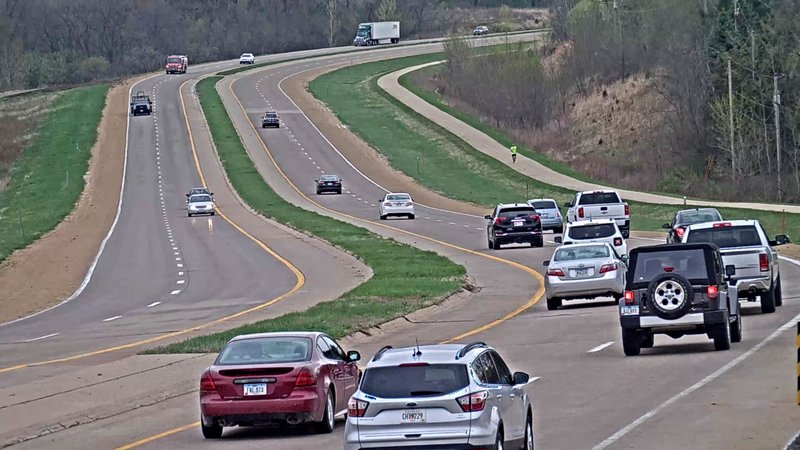
Fig. 2 TL1250 spanning 4 lanes of traffic while monitoring over 70m of high-speed traffic
Advanced systems
Cameras must provide high enough image resolution for good number plate recognition. Roughly 100 pixels across the number plate is a good target. High resolution 4K cameras are becoming standard for these systems allowing approximately 12m field of view - enough for 3 lanes – while maintaining the recommended pixel density.
The image sensor in the camera needs a correspondingly high resolution 4K lens like Theia’s TL1250. It must be sharp enough edge to edge and collect enough light to capture a blur-free image. Motion blur is eliminated in ANPR cameras by looking 100-150m down the road, with a 20-30mm (or longer) telephoto lens (Fig 3). At this range, the depth of field is large allowing the number plate to be in focus over a large change in distance of the car. And the relative angle of motion of the vehicle compared to the optical axis of the lens is small, meaning the image of the car travels slowly across the image sensor. These factors allow the image to be sharp and in focus.
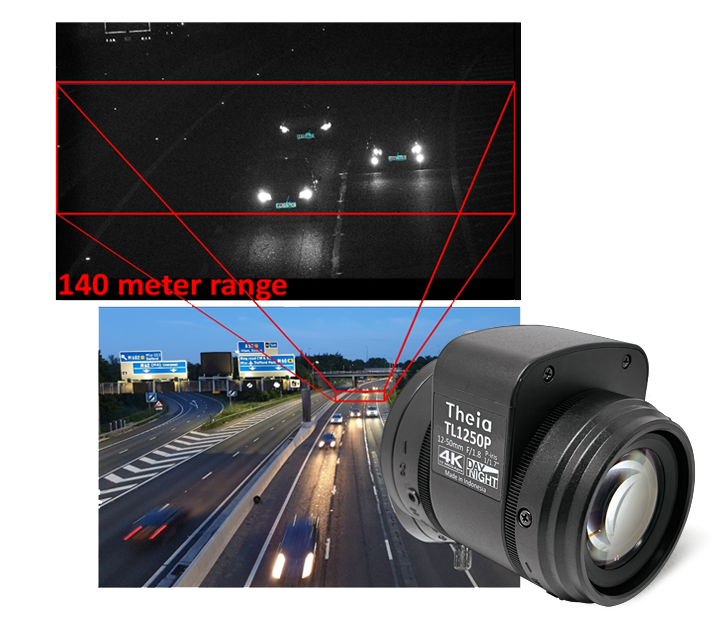
Fig 3. Theia’s TL1250 accurately providing high-speed LPR/ANPR at 140m
A fast aperture lens allowing plenty of light at dawn and dusk will allow the camera to keep a short capture time, reducing motion blur during times of limited natural illumination. Theia’s 12-50mm lens has a fast F/1.8 aperture for capturing a bright image in low light. A good quality, sharp image is required for accurate AI interpretation with minimal manual review of images. This is achieved with a fast, high resolution telephoto lens.
These cameras are usually mounted on gantries across the multi-lane road or in some cases, on poles in the road median. These places are difficult to get to once the road is open so the cameras and optics must be robust, reliable, and remotely controlled. The cost of stopping traffic for the setup and maintenance of the camera is costly. Having lenses that can be remotely commissioned, tuned, and focused is a much less expensive and a much safer option.
Typically, a tolling gantry is set up long before the cameras are ever turned on. A motorized lens like Theia’s TL1250P N6 lens along with the MCR IQ motor controller allows the image to be focused and field of view set remotely once the system is commissioned without the need to stop traffic to access the gantry. Eliminating the need to close lanes decreases the cost of maintenance and increases safety during maintenance.
To simplify the purchasing and installation of cameras, one camera model having versatility for different locations and functions is required. A motorized zoom lens allows more versatility in the system. The field of view can be optimized for each camera individually. There is no need to buy cameras with different fields of view for different places in the tolling system. A long telephoto may be needed for most camera locations with a wider field of view on curves. For carpool lanes, a wider field of view may also be needed. Theia’s TL1250 lens has a field of view that can be changed from 9 degrees for long, straight road sections, to 36 degrees for carpool lanes and toll gate pre-validation. One camera model with a motorized zoom lens can be used for multiple locations and functions in the tolling system.
The physical size of the camera and lens should be small. A compact, high-resolution lens allows the camera enclosure to be small and manageable for installation. Theia’s 12-50mm lens is only 50mm long and has a small control board that can be arranged in the camera for efficient space use. A larger camera will be more difficult for an installer to position and align simply because of the weight of the system. It may also require more support structure, possibly presenting an additional road hazard for drivers.
Environmental demands
Night operation requires the addition of artificial light. To not distract drivers with visible light glare, near IR (NIR) at 850nm or 940nm is often used. NIR is not visible to drivers, so they won’t see a bright flash when passing through the toll system. This also has the advantage that modern car headlights don’t emit much NIR. They are less likely to cause lens glare which can interfere with the image capture of the number plate. Less headlight glare in the lens will improve the image and make the ANPR work better.
Sunlight can be challenging, as it is a broad-spectrum, high-intensity light source that varies in angle and intensity throughout the day and is entirely outside the control of the imaging system. This variability can create glare and reflections on windshields preventing reliable occupancy counting. In contrast, NIR performs better for seeing through windshields in carpool lane applications, even heavily tinted windshields, because it uses narrow-band, artificially generated illumination that is directional, intensity-controlled, and synchronized with the camera. As part of a designed system, NIR minimizes competing reflections and allows glare to be controlled or largely eliminated for more consistent interior imaging.
London’s congestion pricing system uses cameras with 850nm NIR illumination to monitor vehicles with goals of reduced traffic in central London and improved air quality. The NIR illumination is not distracting for drivers at night and is not adversely affected by sunlight during the day. Additionally, the cameras can differentiate between electric vehicles and other vehicles. Since one of the goals is improved air quality, electric vehicles will receive a 25% discount on the daily toll, encouraging London drivers to be more air-quality conscious.
Theia’s TL1250 lens has an internal switchable filter that can change from visible light to NIR light transmission. This filter can be controlled remotely allowing simplified commissioning of cameras. One camera model can be used for applications that use artificial NIR illumination when needed (by location or time of day) and visible light at other times.
Other environmental factors like snow and ice, dirt, and poor number plate condition are mitigated by a sharp, high-resolution image, which captures greater pixel density and finer edge detail. Even when characters are partially obscured, the additional image data helps to preserve enough definition and contrast for reliable recognition, increasing the likelihood of accurate plate reads under adverse conditions.
Theia’s TL1250
Theia has created a high quality motorized telephoto lens that helps camera manufacturers meet as many of these diverse goals as possible with one camera model. The lens has 4k resolution, fast aperture for collecting light, motorized focus and zoom for remote commissioning, internal NIR filter switching for versatility, all in a very compact package. This allows accurate number plate recognition and passenger counting at highway speeds.
The TL1250P-IQ system includes the lens, the MCR IQ motor control board, embedded intelligence with focus/zoom calibration and back focal length calibration, and GUI-based control software to streamline integration and deployment. This fully integrated system reduces time to market for camera designers and installers, thus reducing the cost of development.
Summary
As tolling and traffic enforcement move toward fully automated, high-speed operation - optical performance is key to reliability, safety, and revenue. High-resolution imaging, NIR illumination, and motorized lens control are essential for accurate ANPR, occupant detection, and consistent performance. Theia’s TL1250 delivers 4K resolution, NIR correction, and intelligent motorized control in a compact form. This lens is ideal for carpool lanes, multi-lane tolling, long-distance ANPR. Together, these lenses support full-range intelligent transportation systems, providing the optical precision for data-driven roadway infrastructure.